Olive Pink Botanic Garden – Alice Spring
We had a list of things to do in Alice Springs which didn’t include a visit to a botanic garden or any garden, a bit odd by my standards. A friend suggested that I should visit the Olive Pink Botanic Garden which I duly did(thanks again Wendy). Google maps provided me with an address and directions. I reached my destination and purchased a guide-book and set off into the Garden. The following is taken from page 2 and 3 of the guide booklet.
“The Australian Arid Regions Native Flora Reserve, now the Olive Pink Botanic Garden, was founded in 1956 after lobbying by Miss Olive Muriel Pink. An unconventional anthropologist, an outspoken advocate for Aboriginal rights, a botanical artist and a women ahead of her time in promoting the cultivation of Australia’s native plants, Miss Pink was the Garden’s honarary Curator from 1956 until her death in 1975, aged 91. Opened to the public in 1985, the Garden has over 600 central Australian plant species, including 33 that are rare or threatened. It provides important habitat for the Black Footed Rock Wallaby and many other native mammals, frogs and reptiles. More than 80 bird species can be observed here.”
Unfortunately the garden had been destroyed by what people are calling a one in a hundred year storm. A hail storm had completely ripped leaves and flowers off everything.
 Fortunately there was still a lot of things to look at and enjoy, particularly new species that I had never heard of before and the setting was idyllic, peaceful and quite in the midst of a major city. I made my way to the top of Annie Myers Hill where there was a fantastic view over Alice springs and the surrounding area.

Alice Springs

Anzac hill Memorial and Lookout

Alice Springs with dry Todd River

Todd River with a smidgen of water

Alice Springs

Alice Springs

Heavitree Gap in Alice springs

Heavitree Gap in Alice Springs

View over Alice Springs towards the West MacDonnell Ranges

Looking to the East MacDonnell Ranges
As I made my way up the hill climb towards the top of Annie Myers Hill I came across a Wattle with a bizarre common name, Dead Finish.
Acacia tetragonophylla apparently is the last species to die in a severe drought i.e.- Dead finish. This spiky wattle grows to about 3 metres high and is found across inland Australia in a range of habitats. Very showy when in flower.


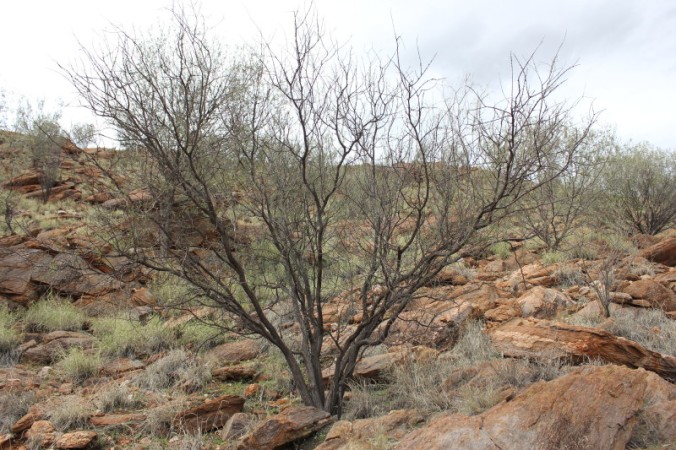 You can see it has quite a twiggy appearance which provides good habitat for birds. The above photo makes it look dead but it is missing quite a few leaves from the hail storm although the leaves are like needles. A tree I had never heard of before is pictured below, Atalaya hemiglauca , Whitewood. This tree grows to 7 metres and has creamy flowers in the warmer months of the year. Occurs across central and eastern inland regions. Would look good in a garden setting or Parkland.
 Aboriginal people harvest witchetty grubs from the roots of this tree. Soft timber used to make ornaments as well.
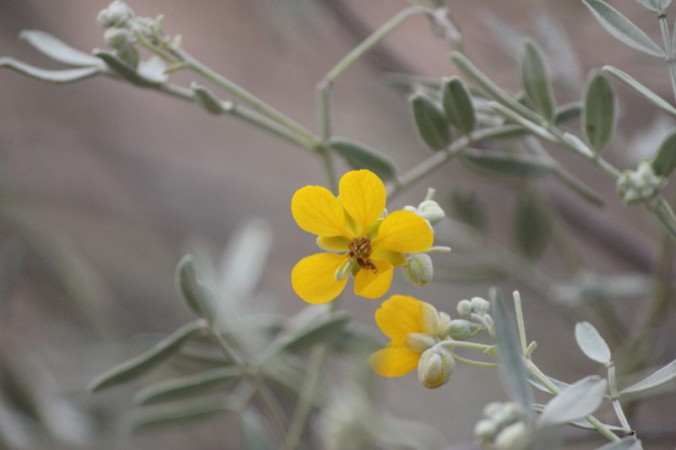 Above is Senna artemisiodes subsp. sturtii which is also known as Dense Cassia. This is a very attractive garden plant particularly while in full flower. Grows to about 2 metres. Saw plenty of Cassia’s Dense or Silver coming into flower. Certainly stand out even on roadsides. Here’s a few more different Wattles.

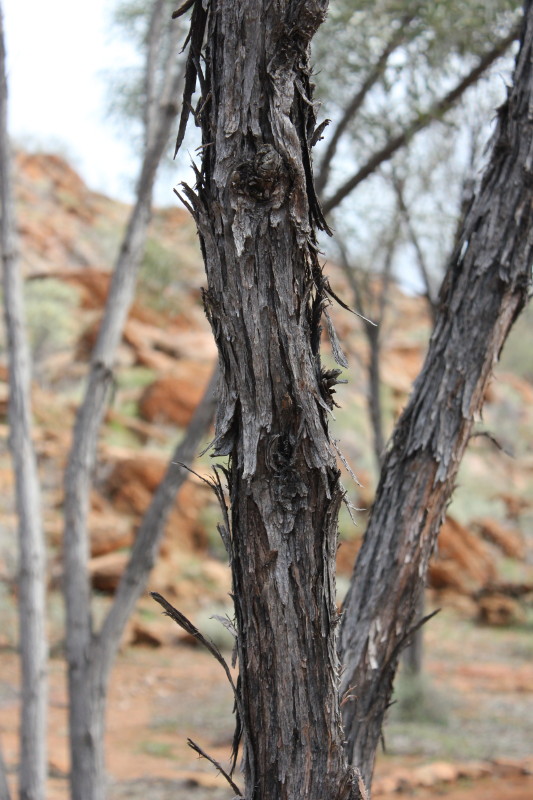 Acacia undoolyana , Undoolya Wattle has limited distribution in the East MacDonnell Ranges, grows to 15 metres and has a spectacular floral display in August. This plants status in the wild is Threatened due to hot summer wildfires and that it doesn’t set seed readily.
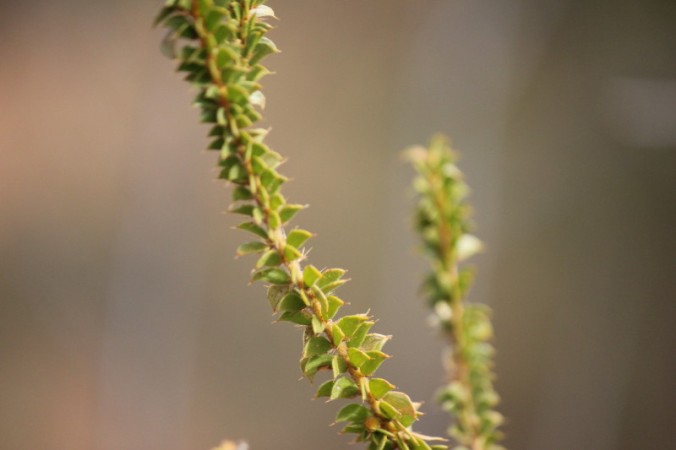 Acacia stipulosa with small interesting leaves. Below is Acacia kempeana , Witchetty Bush which is drought and fire tolerant. Witchetty grubs are harvested from the roots of this small tree. The Arrernte people also use the inner bark from the roots to make string.

 Below is a bizarre looking Wattle called Waddy Wood. Acacia peuce is a threatened species known from only three different populations on the edge of the Simpson Desert. Grows to about 17 metres with immature plants being very spiky compared to mature specimens which have pendulous branches. Used traditionally for clubs and by early European settlers for fences.

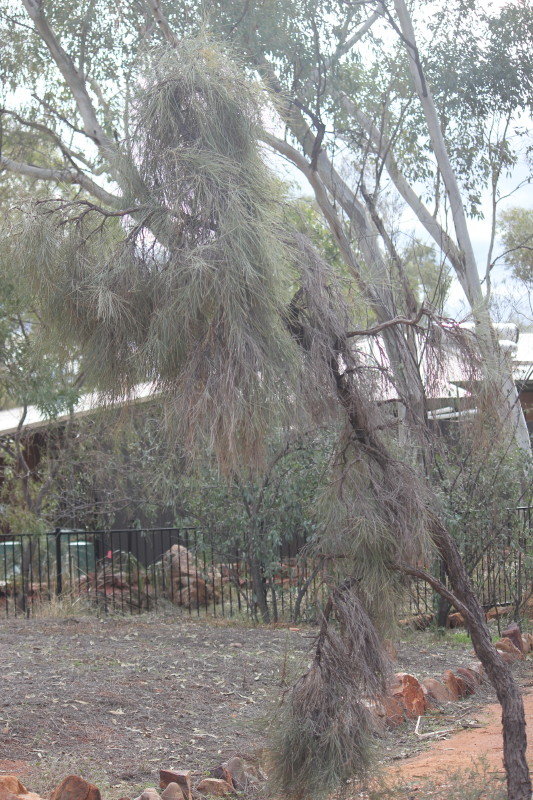 Acacia desmondii , Des Nelson Wattle is found in the Rodinga Range south of Alice Springs. Grows to 5 metres on sandstone ridge habitat.
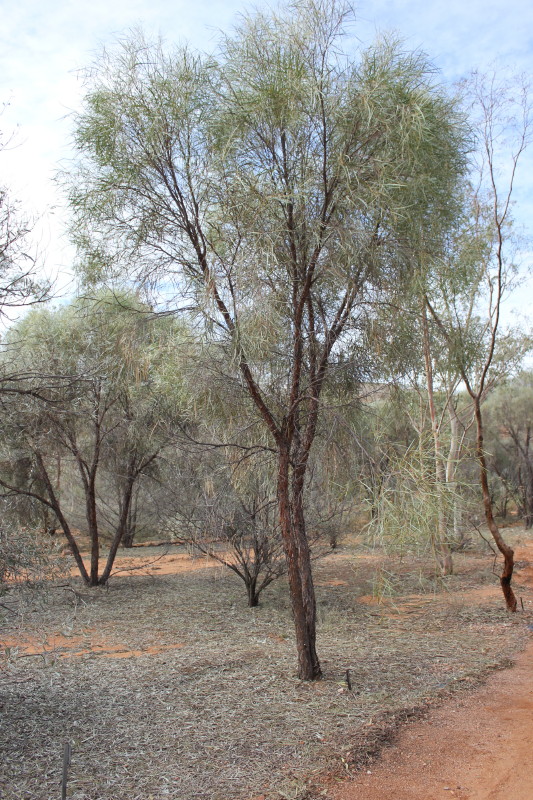
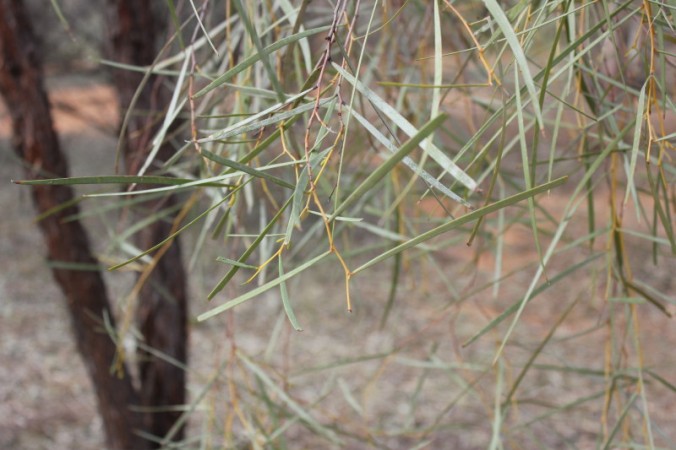
Below is Acacia aneura , which is commonly called Mulga. Mulga occurs in red earths in groves and is one of the most widespread Wattles in inland Australia.

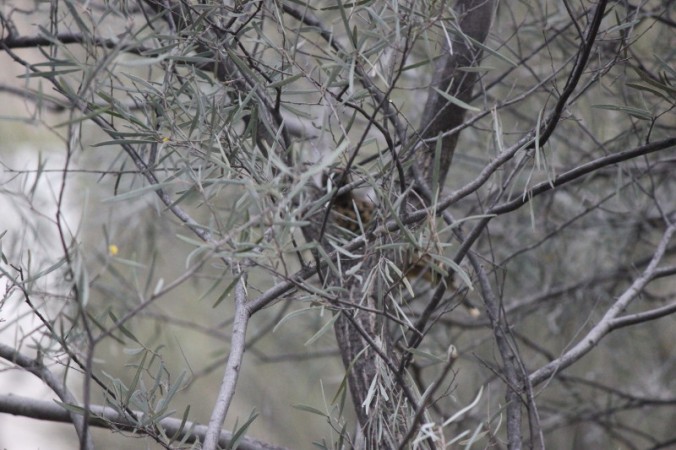 Seed from this plant is an important bush food throughout the region, it also produces Mulga Apples, a gall that forms around insect larvae which is consumed as well. The timber is widely used as firewood and traditionally for making shields, digging sticks and woomeras. There also 2 types of mistletoe that co habit this tree. Amyema maidenii and Amyena spathulata(you will see this in a later post).

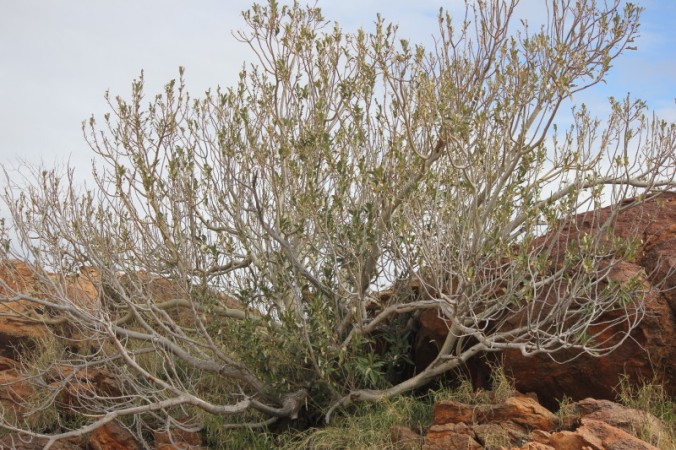
Below we see the native fig, Ficus brachycoda. I saw this in quite a few different locations in the Macdonnell Ranges and Kata Tjuta National Park(Uluru and The Olga’s).
 Now for some Mallee’s. Mallee’s are multi stemmed tree’s from the genus’s Eucalyptus and Corymbia. There’s approximately 1000 different species of Eucalypts and Bloodwoods, don’t panic I’ll only show a couple!!
 Above is Eucalyptus sessilis the Finke River Mallee which occurs in the ranges south and west of Alice Springs. This Mallee has smooth bark and large leathery leaves on a small multi trunked tree. Flowers are creamy yellow. This Mallee has nice orangey/brown coloured trunks and branches, noticeable when the bark is peeling. Below we have Eucalyptus oximitra , the Sharp Capped Mallee.
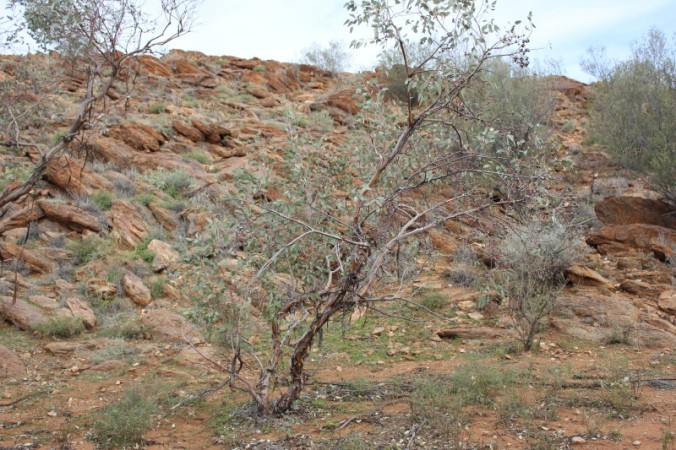 This Mallee grows to 6 metres with leathery leaves and large yellow flowers during the summer months. Can be found on sandy plains or rocky hills in arid parts of Australia, mostly S.A, N.T, and W.A. Below you can see its capsules.
 Last but not least of the Mallee’s is Eucalyptus gamophylla , the Blue Mallee which can be found in many arid parts of Australia. Growing to about 8 metres with blueish coloured leaves, juvenile leaves are round and creamy white flowers during summer. Found on rocky hills or red sand country. Seeds can be eaten and water can be found in the roots if desperate!
 What about Erythrina vespertilio another tree I had no idea about. The Bean Tree or Bats wing Coral tree has extremely light wood which was used for making shields and bowls.
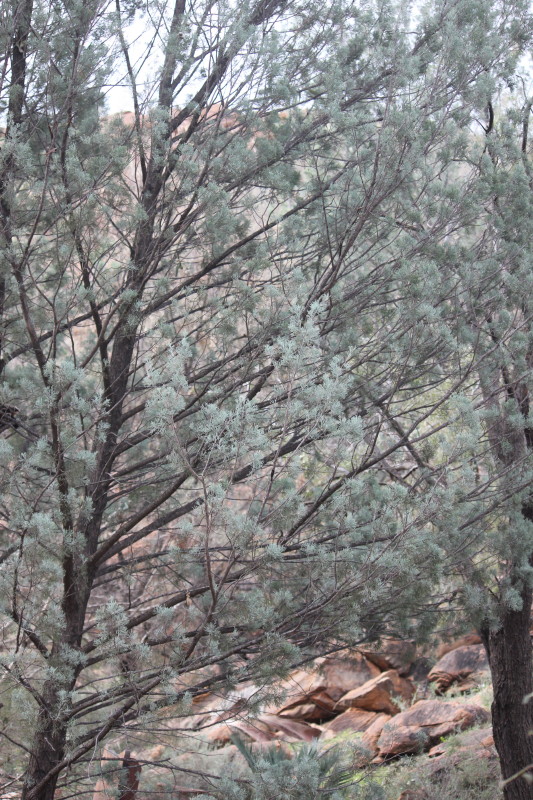
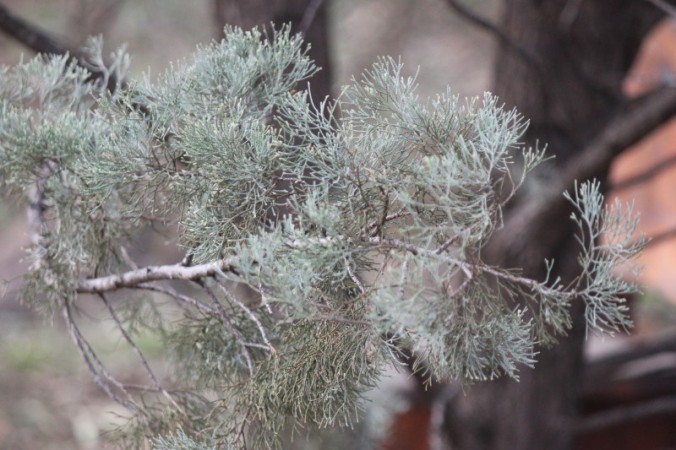
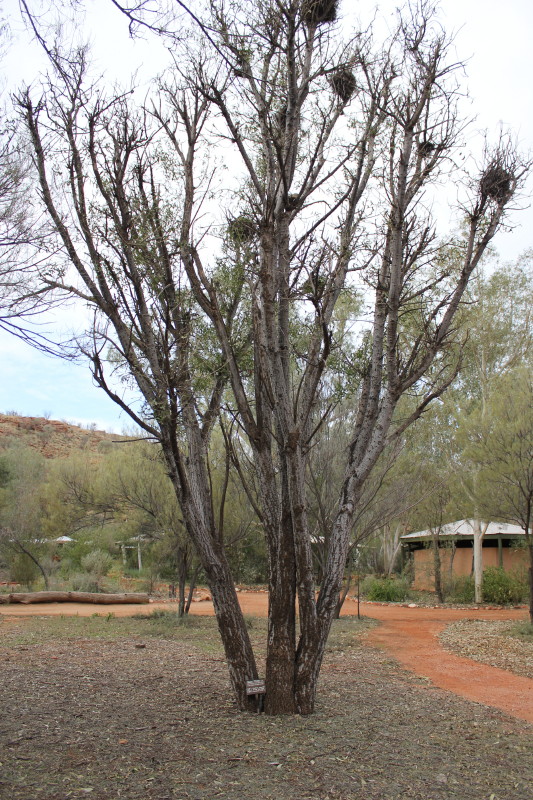 Looks like there’s a few nests in this one. Grows up to 15 metres with leaves that are shaped like a bat. it also has quite stunning red/orange flowers. It also loses its leaves when it flowers in spring and summer. All in all by visiting the Olive Pink Botanic Garden in Alice Springs I have learnt a great deal about new(to me) varieties of Wattles and Eucalypts and even new species of plants which is very exciting. Astounding to learn how the Indigenous people use these plants as well. Next time you’re in Alice Springs, do make sure you drop in and have a look, its well worth it. To finish up here are some photos of a native conifer, Callitris glaucophylla , White Cypress Pine grows to somewhere between 7 -20 metres with blue-green cypress like foliage usually with a single trunk. White Cypress Pine is known for being extremely Termite resistant. Quite a nice conifer that is widespread across the country.
 Stay tuned for part 3, coming soon!!
Cheers.
 Above is the Olive Python, Liasis olivaceus. My goodness this fella was huge, lucky the glass didn’t just vanish hey! Adults can reach over 4 metres in length, the second largest snake species in Australia. Dinner also includes the below pictured, Rock Wallaby, Yum! That’s quite a mouthful….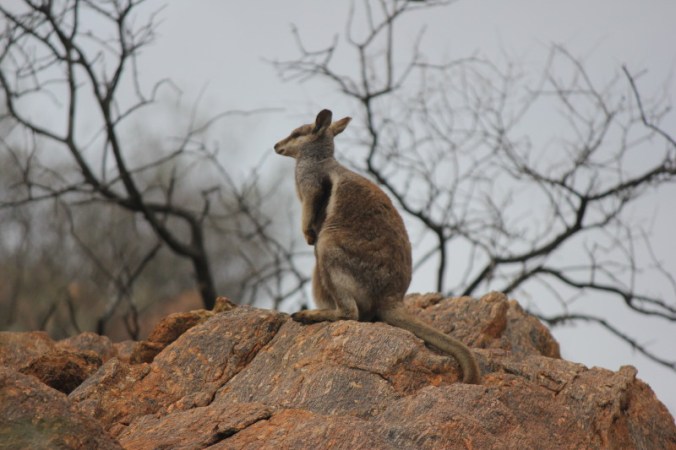

 Pogona vitticeps, aka the Central Bearded Dragon pictured below can grow up to 60cm in length with the tail accounting for approximately half of its length. Central Bearded Dragons can be seen with a range of different colours, browns, reddish-brown, red, white, orange and yellows.
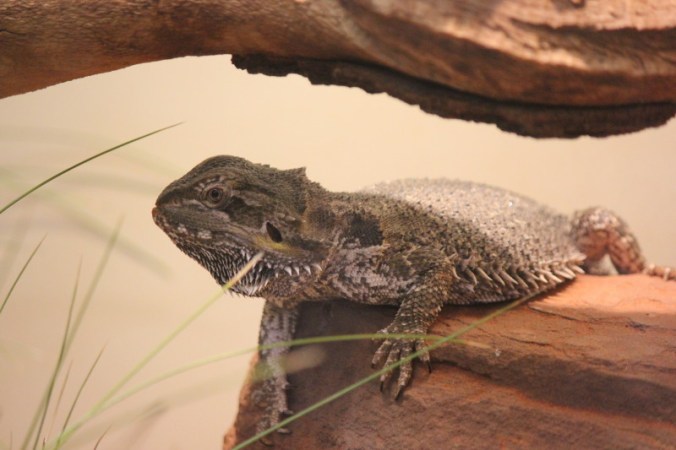 See his scary beard under his chin, used to intimidate would be tacklers! When threatened they flatten themselves, puff up their throats and open their jaws to look bigger and more fearsome. The photo below shows a different coloured Dragon, they change colour to regulate their temperature.
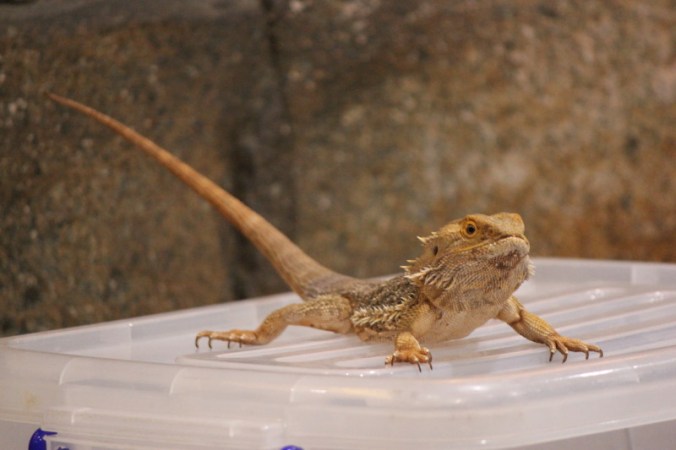 We were able to pass this fella around which was pretty cool! Quite soft to touch apart from his claws.
 Here is the Centralian Carpet Python, Morelia bredli growing to 2 metres and in captivity its known to get to 3 metres or more. Don’t think we need to dwell on this anymore, moving right along!!
 Talking about Brown snakes, here’s the King Brown, Pseudechis australis. Another one to give a miss or go the long way around!!
 Luckily its a bit out of focus so it wont see you!! Here’s a few more animals from the Alice Springs Reptile Centre.


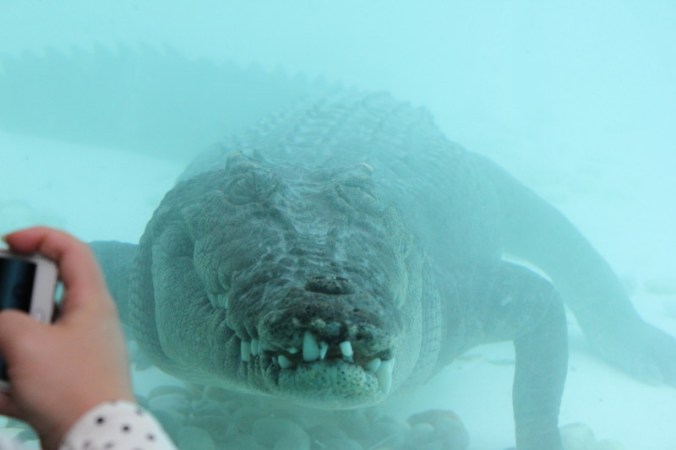 Never ever touch croc infested water, if you do you will be dead(most likely), vibration for them is like pollen to a honey bee. If you see their eyes break the water surface, you have just been triangulated, they know where you are. If you’re walking past croc infested waters – make sure you have a small dog with you. They are far more interested in small animals than they are in you. There is no such thing as a death roll, you are already dead, they are just trying to rip a piece of you off yourself because their hungry. They kill their prey by drowning them and it only takes a minute or so, no rolling required Their teeth are quite blunt and they tear pieces off, so that’s why you get rolled around. . See, not a death roll, more like a subway sub being prepared! So on that happy note, have a great day and look out for Terry!
 Having ticked of several different lists, scratched my head more than a few times, what else do we need, what have I forgotten, do I need this if this happens? Time is fast approaching when the road will be calling us and I think we have everything packed, a bit late now if we haven’t! There is so many little things that you need to think about when your leaving on an extended holiday over what may include rough terrain. Major items may include bedding, clothing, food, cutlery, plates, cups, toilet paper, shovel. Did you swap the gas bottle over? Minor items may include, well what do you class minor, something that’s small? What about spare nuts and bolts, hose clamps, D shackles, tools, wire? I’m afraid nothing is small on a big trip like this, many things can go wrong.
 Morning tea saw us in Deniliquin for a quick cuppa and a fuel stop. Everything seemed to be holding together and the bikes were still behind us, always a good sign.
 Lunchtime had us in Balranald and it was still cold. I did have shorts on but always find that more comfortable to drive in than jeans or trousers. To me car interiors can become quite warm and make one sleepy. Not a good thing. We pressed on for Mildura then Cullulleraine for another fuel stop. By this stage the sun was truly starting to sink in the western sky. Our dream of reaching Morgan on day 1 was evaporating as I was not willing to risk dusk and night travelling through kangaroo infested territory. We headed for Renmark and decided to call it a day there.
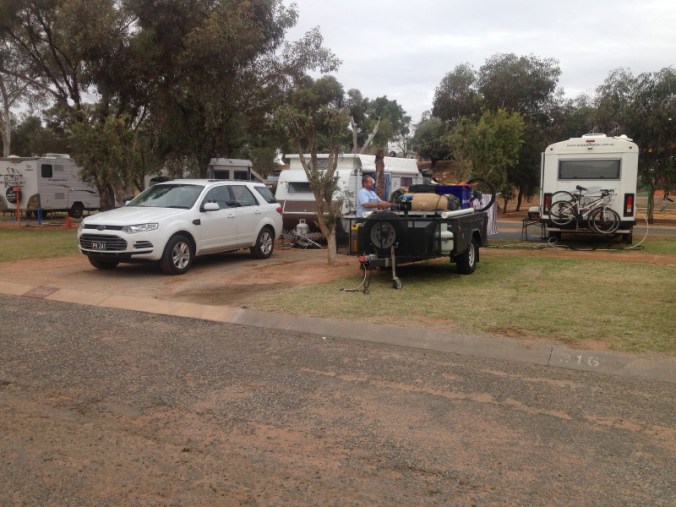
 Camped by the Murray at a free camp site amongst the gum trees, wonderful, plenty of firewood! Wrong, there was no firewood. All those pesky campers before us had cleared any fallen wood out of there. Small twigs and plenty of bark had to suffice, amazingly we made do!
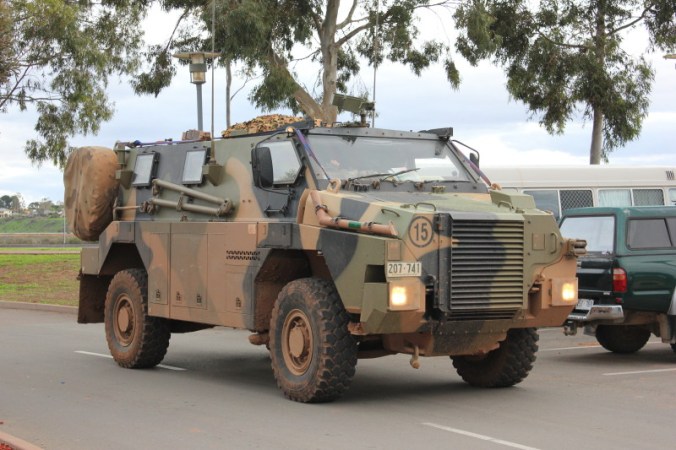 Bushmaster, now that’s one solid vehicle and even being in a Pajero ourselves as I pulled up beside one I was still looking up to its drivers window. We pushed on through Port Augusta, came to a roundabout. Left was the Eyre Highway and Western Australia, right was the Stuart Highway and the Northern Territory. Right it was and now we were really heading north. We made it to a destination I like to call “Somewhere on the Stuart Highway about 70km south of Pimba”.


 You get use to the road trains pretty quick because they go all night long. Three or Four semi trailer behemoths all joined together rumbling along in the dark getting louder as they approach you. The other problem was the other type of train, lights piercing the darkness a rumbling noise getting louder and whoosh, a goods train rolls passed on to some far-flung destination. Lucky there was only 2 overnight.




 huon perennials