Plants in Focus #5

Hi there!

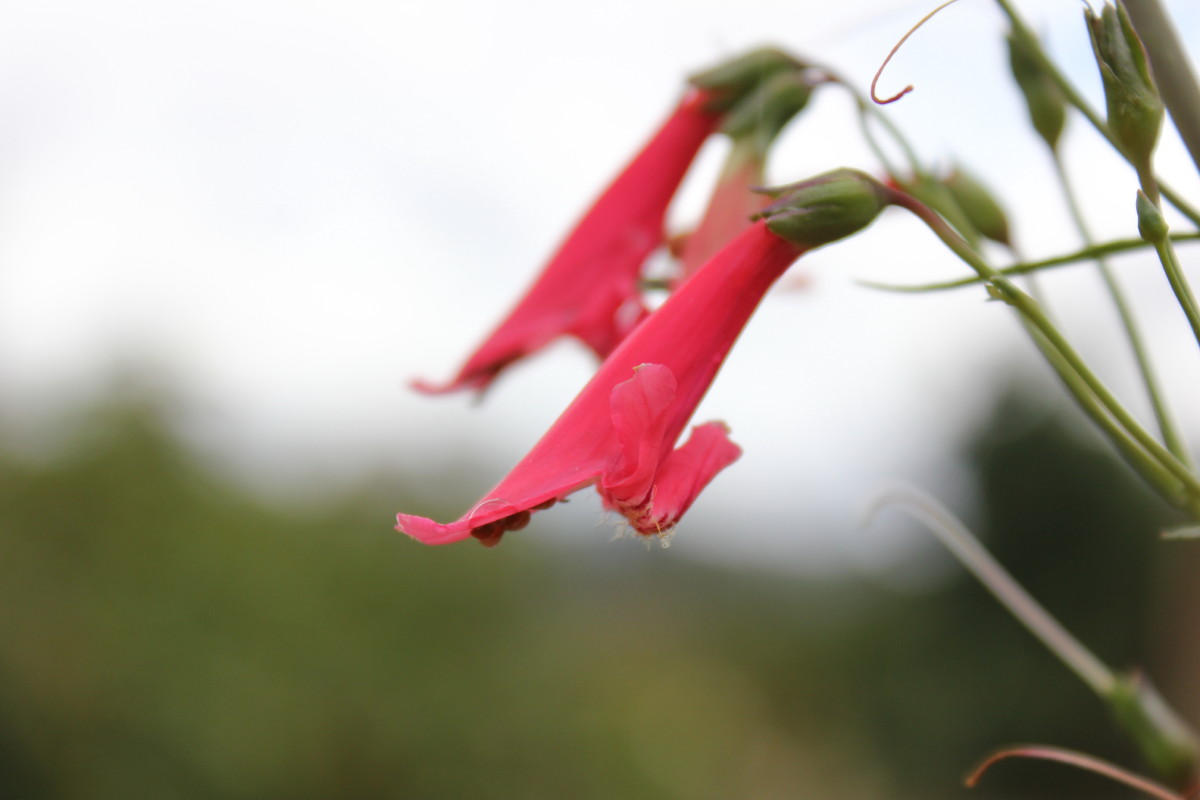
In this edition we will look at Penstemon barbatus, an outstanding member of the genus Penstemon  also commonly known as Beard tongues.  Penstemon barbatus commonly called Scarlet Bugler, is a beautiful plant flowering in summer with scarlet red flowers on tall stems to 90-100cm tall.  Stems can sometimes be shorter or taller as well.  There is also pink varieties available, yellow too.  The lower lip of the corolla is bent back sharply giving it a shark’s head silhouette, see below.

IMG_0347

Barbatus means bearded and this is evident on the palate which is densely yellow bearded.  See below.

IMG_0251

Basal leaves are glossy, 5-13cm long and mostly lanceolate or they can be ovate or spatulate.  Edges can be wavy or smooth.  The cauline leaves(on the stem) are linear to lanceolate and stemless.  The plant has a woody base with glossy leaves arranged in large basal mats.  I have one that’s about 50cm wide.

IMG_0345

See above basal leaves and below a close up.

IMG_0353

Below are the cauline leaves

IMG_0352

Not normally a long-lived plant usually 5-10 years, longevity can be increased by deadheading.  Commonly pollinated by humming birds in its native habit although bee’s will pollinate as well.  I have found this Penstemon easily grown from stem cuttings.

IMG_0346

Notice above how the stems rise majestically above the foliage, and below is a closeup of the flowering stem.

IMG_0259

Native to Colorado to Arizona, Western Texas, New Mexico, Northern Mexico and South Utah, growing on dry hillsides and flats in sagebrush, pinyon and juniper, ponderosa and gambel pine communities.  Seen at altitudes of between 1300-2700m.  Will grow in a variety of soils but needs excellent drainage in area’s of high rainfall.  Drought and frost tolerant, best in full sun but will tolerate part shade as well.

IMG_0263

An excellent Penstemon to grow in any garden situation for a flush of bright red flowers to brighten your day.

IMG_0253

IMG_0248

Cheers!

A ghostly tale

Hi There!

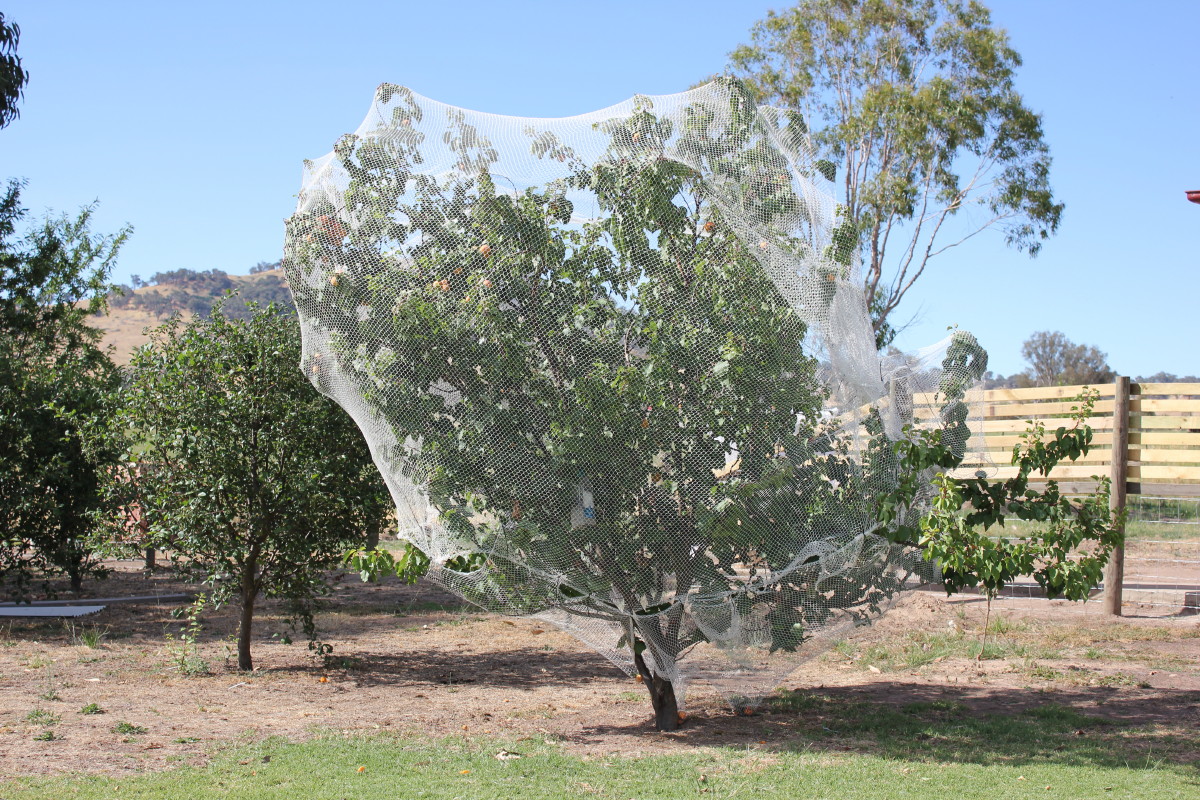
The poor apricot tree must have seen a ghost a couple of weeks ago, it turned white!

IMG_0209

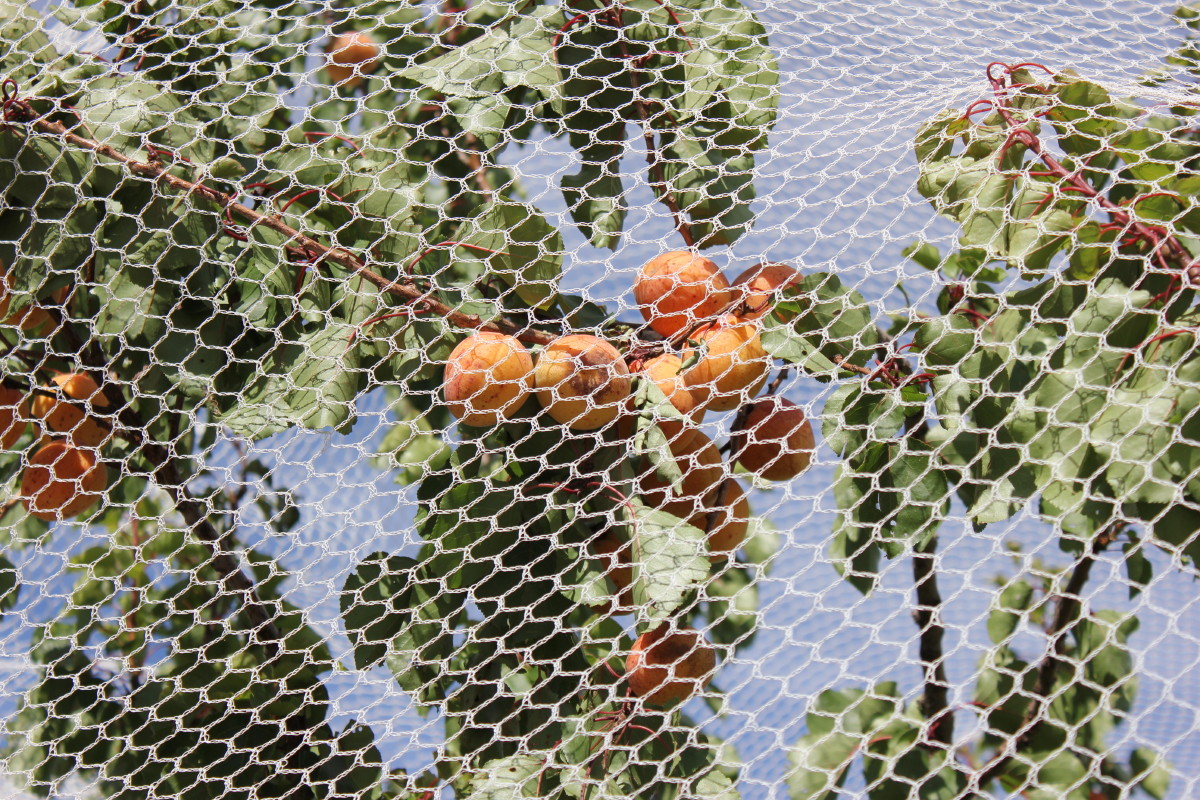
Silly me its only the bird netting.  Sorry birds you’re getting zip this year since there’s not many apricots on it.  Its been a tough year.  You can have a look if you like but this is as close as you’re getting to them!

IMG_0204

Looks like its time to pick them and today was the day to do it since I only noticed them ripening up nicely this afternoon.  amazing how quickly they ripen and if you miss them they ripen too much for my likening.

IMG_0211

Excellent, here we go.  Looks like the ghost’s have moved on.  Better get in there quick before the birds arrive.

IMG_0210

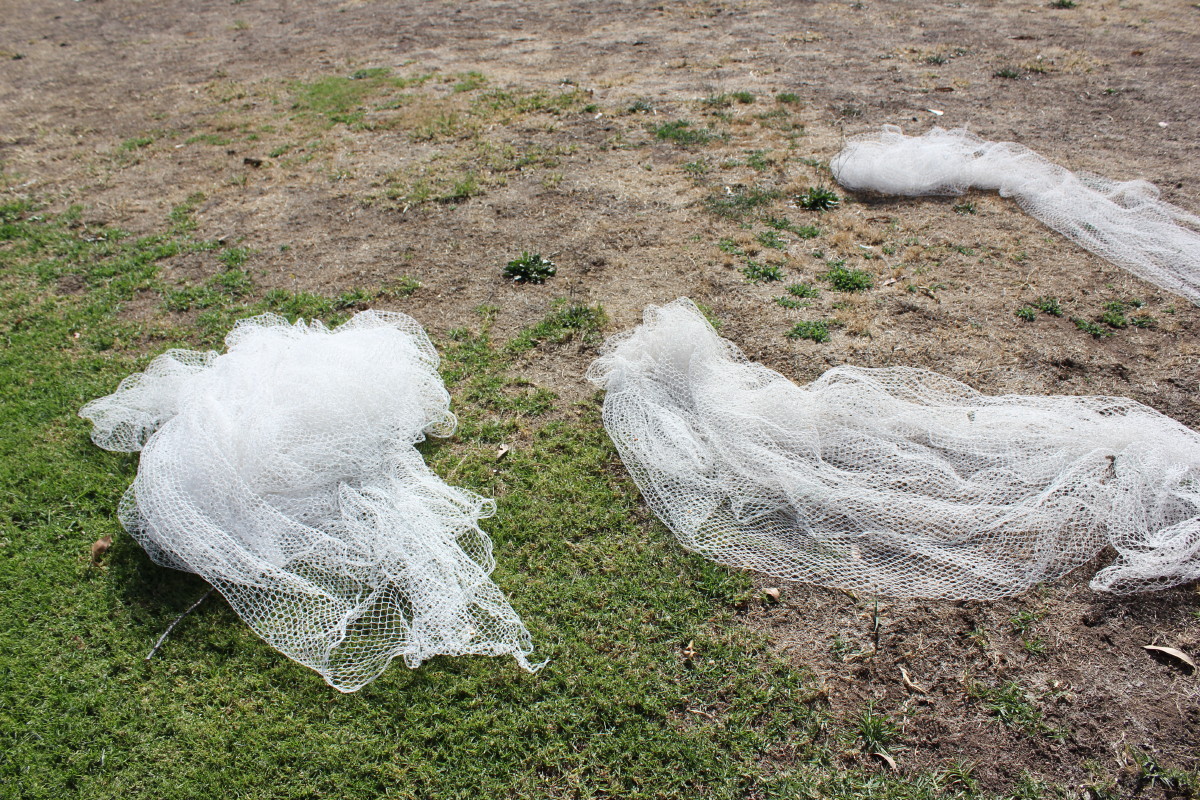
Yum!  Oops! there go the ghost’s to the next unsuspecting tree.

IMG_0214

Glad we got rid of those scary things.  There’s more apricots than I thought.  Fantastic!

IMG_0215

Just in case you didn’t see the above photo, look below!  Apricot Trevatt if you’re wondering.

IMG_0216

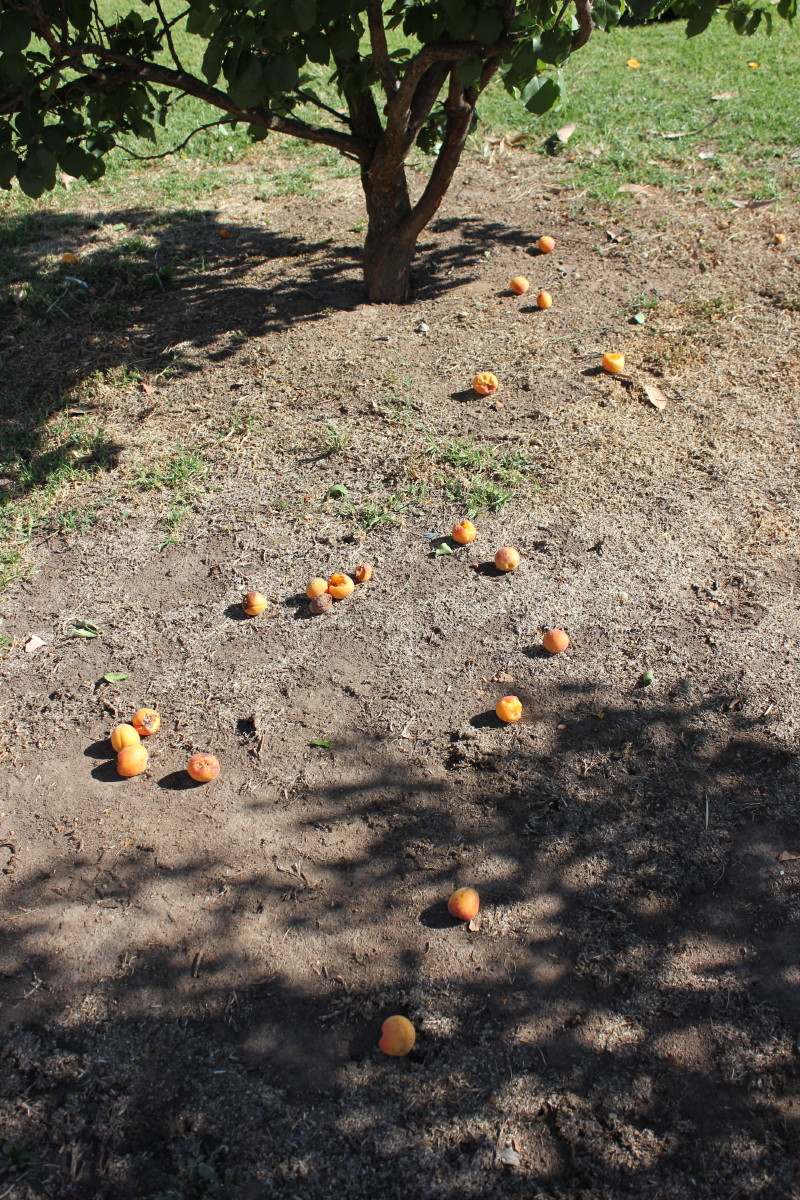
These on the ground are rolling down to the chook pen.

IMG_0217

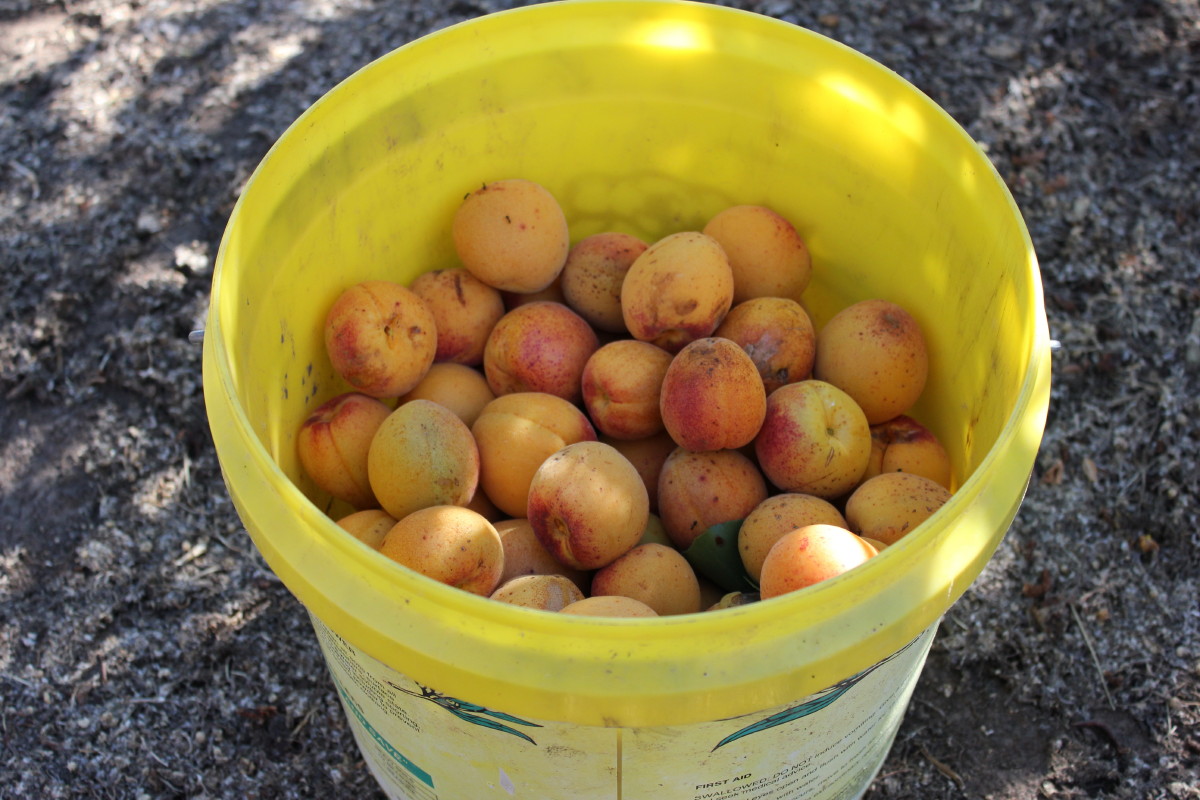
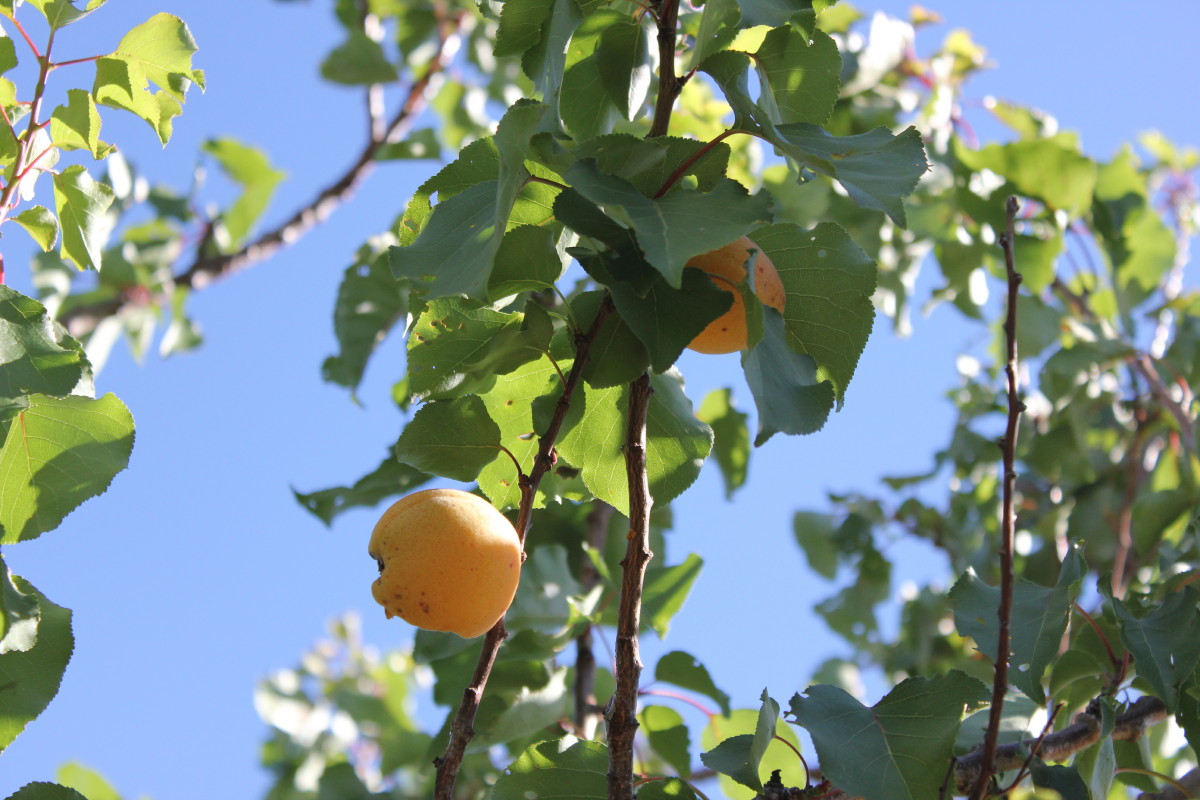
And these ones I will leave in the tree as an entrée for my feathery friends!

IMG_0218

Nothing like freshly picked apricots with a pungent ripe smell, magnificent, and if you can’t eat them all before they get past there best.  Throw them in the pot and stew them for a beautiful addition to your cereal at breakfast time.  Apricot jam any one?

Cheers!

Here comes another one again..

Hi there.
I heard an alarming piece of information today. Are you sitting down? Good.
Here we go, yes its a bit scary I know, but hot cross buns will be in the supermarkets from the 6th of January.  Weird I know, we haven’t even had Christmas yet.  The sad thing is though that I wouldn’t mind if they were available all year round.  That way you could have a couple or three or more during the year and you wouldn’t then need to cram them all in during Easter so that the taste would remain with you until next year.  Easter eggs they can keep confined to Easter because they taste like second-rate chocolate unless your buying Godiva ones.

Christmas mince pies are another thing that needs to be available all year round.  I suppose one could make them anyway if the cravings were to great.  Bakers Delight ones are just a little bit too nice if you ask me.  Nearly as good as home-made ones.  That’s a hint if anyone is wondering.  Christmas fruit cake is allowable all year as well(i know you can get fruit cake any time of the year, it’s just another hint).  Marzipan’s very good to!

Onto something other than food, what about the Poinsettia’s you buy at christmas time?  I’m personally not a fan of them yet they are quite stunning with those red bracts(other colours readily available now).  Did you know that they are native to Mexico which is in the northern hemisphere obviously, and that they flower in winter time.  So you can imagine the headache these poor Poinsettia’s have being six months out of whack.  The silly thing is though is the trouble we go to to  grow these plants at the wrong time of the year to satisfy the consumer.

Chrysanthemum’s are another plant with a headache.  Normally flowering in spring/summer yet we like to force them into flower  late April early May for Mothers day.  Poor things, no wonder over the counter chemist dispensing is rising.  Stunning shapes and colours, yes!  Fan?  No.  Another hint.

By the way, the Bureau of Meteorology got it right the other day.  They said 30-60mm of rain would fall.  I got 38mm, a round of applause please, thanks.  We may have a green Christmas yet!

Cheers!

Here comes another one

Hi There!

When I was a young boy, so many long years ago now.  It seemed that time was nearly traveling backwards and that the intervals between each Christmas were immense.  How times have changed, hey!  You just need to take about eight blinks of the eye and another Christmas  has arrived.  I arrived at the eight blinks time frame after in-depth scientific analytical consideration concerning the time frame between blinks and its relationship to sequential fullofitness. How do I know Christmas is fast approaching?  Well, apart from the calendar informing me with alarmingly larger printed dates as the month goes on, here are a few more indicators.

Have you had enough of the Christmas carols in shopping centres?  That’s a good indication that Christmas is not too far off.

Have you noticed the tired old Christmas decorations put up by your local council?  Or maybe its the Fake tree that’s appeared in your home.  There’s one in our  home.

IMG_0135

Or maybe its the swarm of insects outside(or inside) your home on those hot summer nights!  A problem when they get in your ear when one is sleeping.

IMG_0133

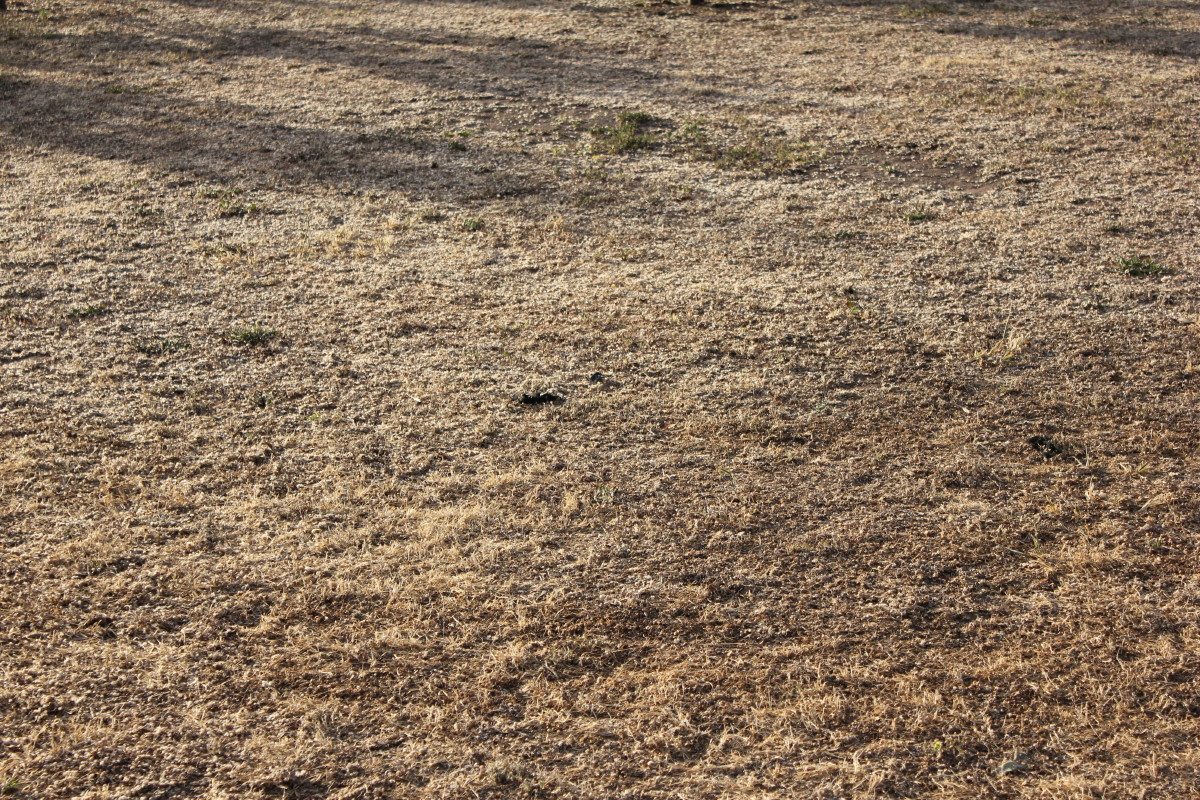
This is a peculiar insect that makes circles on the fly screens.  Only kidding, the mesh was pushed against the glass.  I realise that it might be hard to comprehend for those in the northern hemisphere, but as your hemisphere is cooling  ours is heating, so no white Christmas here.  More likely they are brown ones.  The records indicate for the last 10 years from my location that Christmas day averages roughly about 30 degrees Celsius which isn’t to bad.  The hottest day in December in the last forty years was in 2005 and on the 31st where it reached 41.8 degrees Celsius.  Most northern climes no doubt are hovering around zero or below or above, quite a contrast.  I still haven’t worked out how Santa and his reindeer’s manage to acclimatize to our weather for their short visit, particularly when one is wearing a red suit.  Here’s a brown Christmas(below photo).  Our hottest months though are normally January and February and normally at the end of February you will get a week of 40’s just when the kids go back to school, lovely!

IMG_0121

And a close up of our back “LAWN”

IMG_0118

Dead weeds really.

Today we got to 32.4 degrees Celsius and tomorrow we are expecting 30-60mm of rain, so maybe the brown Christmas will turn into a green Christmas.  Thursday will be down to 20 degrees Celsius and snow above 1000 metres at time according to the Bureau.  Some lucky person may get a white Christmas after all, or a white December day.  Weather!  It’s a funny thing, is it not?

Maybe there are other things that prompt you that Christmas is just around the corner.  It could be the mad rush to buy those presents that everyone will enjoy.

It could be the price of petrol rising.  Mind you, that’s every second week anyway.

Maybe it’s those Christmas lights that need to go up outside.  That reminds me, thanks.

it could be those Christmas cards that are appearing in the mail.

Maybe its school finishing for the year.  Don’t remind us please!  The kids will be home everyday for 8-10 weeks!

Maybe there are many other things that remind you that Christmas is just around the corner.

Whatever they are, I hope you have a wonderful Christmas with your families.

Cheers!

Mulch Ado About Nothing

Hi There!

Much can be said about mulching, much can be done about mulching but much will be gained by mulching.

Why Mulch?

Here’s the three main reasons why we do.

  1. Reduce evaporation
  2. Change the soil temperature
  3. Reduce the number of weeds

A by-product of the first two points is less water usage which reduces the reliance on water usage and decrease our water bill as well, which I find highly attractive.  What do we use as a mulch?  Lots of things can be used but the most common would be Straw(including pea and Lucerne)/Hay/sugar cane and compost.  There are also more woody ones like Pine bark/Wood Chips including Euchi Mulches.  One can also use decorative mulches like Pebbles/Sand/Gravels.  There are pro’s and cons for all of them, it just depends on your needs and what you are looking for.

Decorative mulches will look good yet provide no benefits or nutrients to your soil.  Organic mulches like straws/hay may not look so sharp yet they provide nutrients as they breakdown.  This improves soil structure and increase the amount of micro organisms in the soil which in turn provides a healthier soil.  Larger particle mulches like Pine bark may cause a symptom known as nitrogen drawdown.  This is because Pine bark is lumps of carbon(that’s what wood is) and the micro organisms in the soil need nitrogen to breakdown the Pine bark therefore they draw nitrogen out of the soil to do this,  creating a drawdown(less) nitrogen in the soil.  A simple application of Blood and Bone or such like fertilizer will solve this issue if it is one.  The other negative,  if it is one for organic mulches is they will need to be replenished each year because they do breakdown into the soil.  I think this is a bonus though, because its doing nothing but good for your soil.

IMG_9330

Above you can see that the hay has broken down which has exposed the soil, leading to more evaporation and the potential for increased weed growth.  Below you can see that while the mulch is still there, it is breaking down and will need to be replenished.

IMG_9333

       1.  REDUCING EVAPORATION

How does this work.  It works two ways-firstly by shading the soil and secondly by slowing the movement of water vapour and liquid from the soil.  Evaporation from bare soil acts like a wick – drawing water from below.  By using a mulch we have broken the wick which of course will reduce evaporation.  Studies have shown that water evaporated over 2 days from bare soil was about 27.9 g/m2, whereas soil with a 75mm thick layer of Lucerne hay was 4.9 g/m2.  A reduction of 82% in evaporation.  (Growing Media for ornamentals and turf, Handreck & Black)

     2. CHANGING SOIL TEMPERATURE

Temperature of soil is lower under organic mulches than soil with no mulch.  Mulches shade the soil and insulate it.  Tests on soils have shown that at 30mm depth below the surface and with a layer of straw 40mm thick on top, the highest temperature recorded over a 24 hour period was 26 deg Celsius.  Where as bare soil temperature measured the same way was 51 deg Celsius.  (Growing Media for ornamentals & turf, Handreck & Black)

Here’s a picture showing bare soil that has dried out and is dusty with hardly any structure to it.

IMG_9273

Below is soil that has been mulched for 4 years and showing good structure and is moist as well.
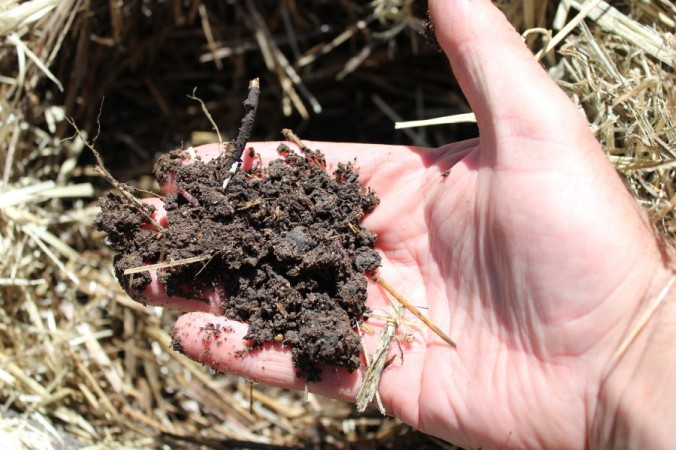
IMG_9268

    3.  WEED REDUCTION

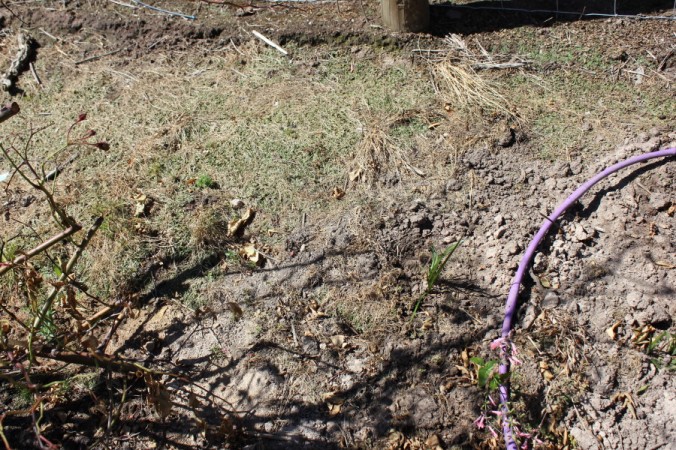
Mulches reduce the number of weeds because seeds mostly need light to germinate and if they do, most will die before reaching the light.  Some will get through, though these should be weakened and easily removed.
IMG_9305

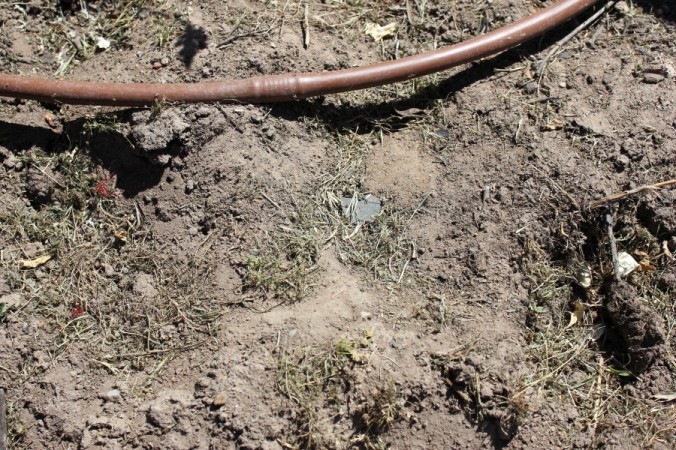
Above and below you can see bare ground with some weed growth even after hand weeding and the soil is drying out as well.
IMG_9272

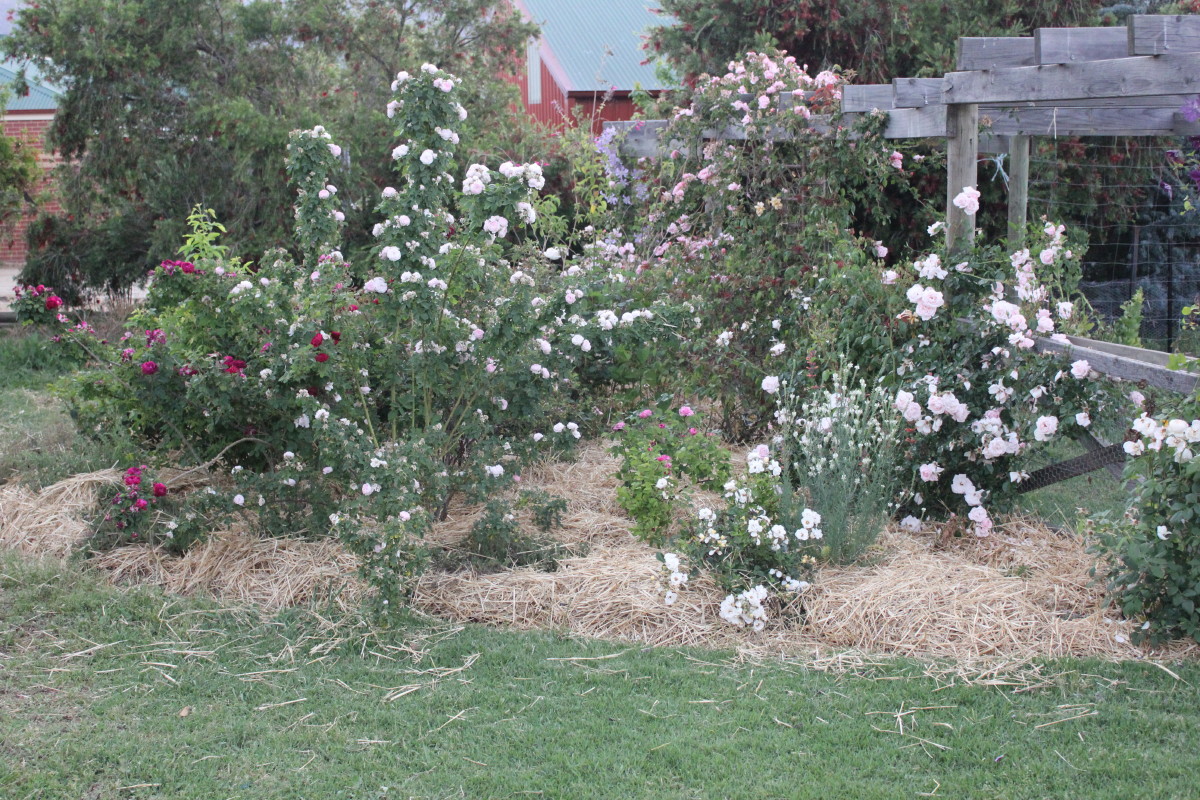
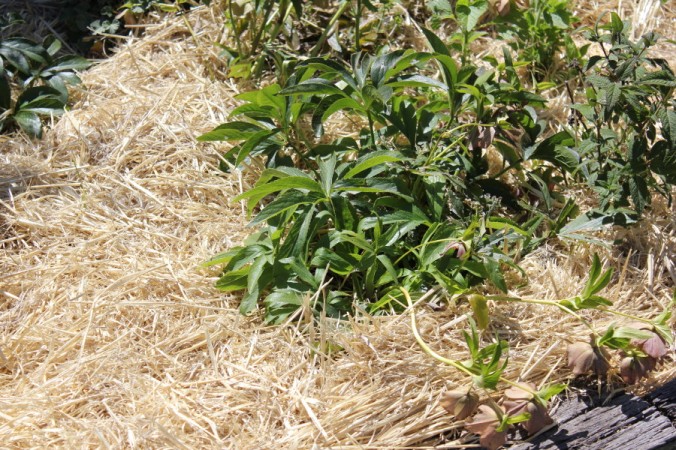
Picture below showing garden beds topped up with mulch
IMG_9271

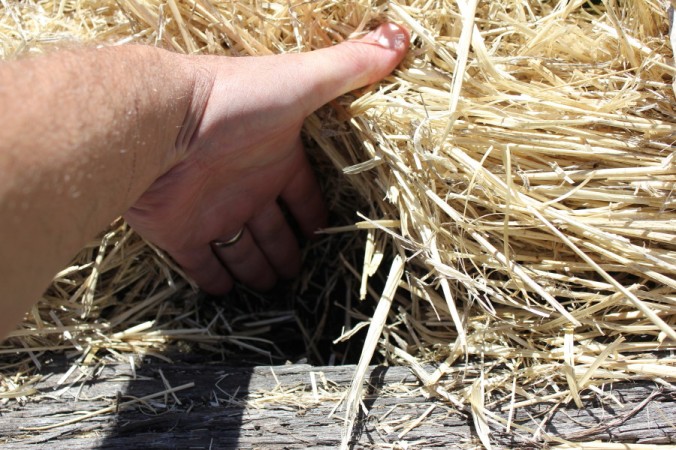
Below you can see the depth that I mulch to, it’s about 60-80mm thick.  Always remember to water area to be mulched well before applying it.  I find it useful to water  after mulching as well.  Seems to stick the hay together slightly which stops it from blowing around and deters the birds for a while as well!
IMG_9270

Of course there are always other effects of mulches, pros and cons of each as well.  Look into what you want to achieve, the look of it, maintenance of it, replenishing it.  Researching it will help determine whats best for you.  As you can see from the photo’s I prefer a straw/hay mulch.

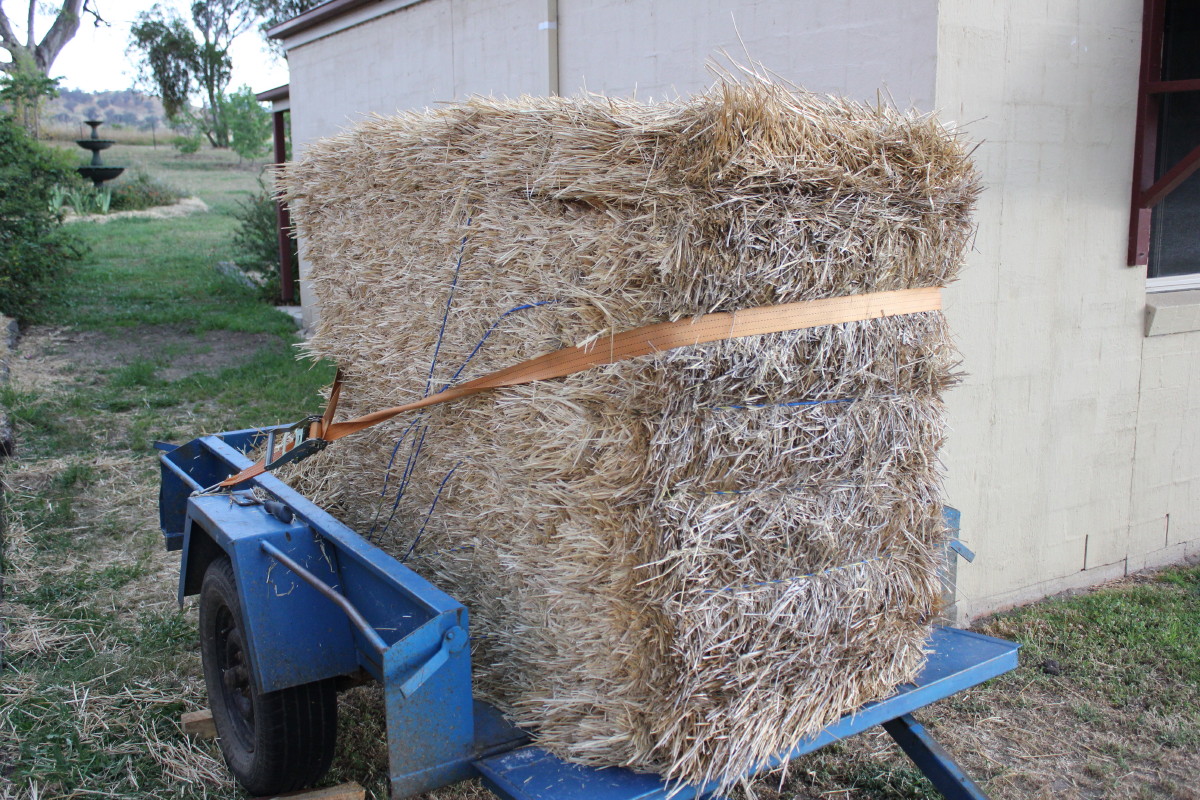
IMG_0098

Above you can see a hay bale being put to good use, and below a freshly mulched garden bed.

IMG_0100_1

And another

IMG_0103

Always make sure that mulch is not in contact with the base of plants(around the stem).  This can cause rotting if it is.

The main thing is there are massive benefits to be had by mulching, and they include,

  • Less watering
  • Less weeding
  • Better soil health and structure (if using organic mulch)
  • Better plant health and growth (if using organic mulch)
  • LOWER WATER BILLS!

We always look at the bottom line in the end and it tells us there’s certainly much ado about mulching!

Cheers!
A gaggle of Geese!

Hi There!

Clematis are a beautiful group of plants and I have a few in my garden which are always stunning when in flower.  I thought I could find a collective noun for them, but to no avail.  A conglomerate of didn’t sound right because their not taking over the world, a gaggle is already used by those pesky Geese, herd and other equivalents are taken by animals, tree’s get a stand.  Fleet and flight are well and truly spoken for, herd and pack are no better.  I have it!  A Cling of Clematis.  Cling because a lot of them cling to other plants to scramble up and about.  No doubt incorrect, sounds alright though.

Moving right along, Clematis is a genus of approximately 300 species from the buttercup family Ranunculaceae.  They became popular from round about 1862.  They are mostly woody climbing vines but some species are shrub like and some are herbaceous perennial plants.  There are both deciduous and evergreen species.  Leaves are opposite and divided into leaflets and leaf stalks that curl and twist around other plants or structures to anchor the plant.  They are mainly found throughout the temperate regions of the northern hemisphere although there are species in Australia and New Zealand as well.

They prefer to have the base of the plant in shade( a cool root zone) and the top half in full sun.  The plants we see are normally the big showy cultivars and there are hundreds and hundreds of them.  The smaller flowered species though will show their subtle beauty as well and are well worth growing for something a bit different and interesting.

This has been just a quick over view of them and here is my Cling of Clematis.  Enjoy!

Cheers!

Roses, Spring 2013, Part 3

Hi There!

The Roses are continuing to come into flower and my finger seems to have a twitch in it when its near the shutter button on the camera, so hope you enjoy these photo gallery’s.  For your information they can also be found on this website under Photo Gallery.  A lot of my photo’s can also be found on FLICKR under the profile(name) JACBD.  You can also click on the photo’s in the right hand column on the home page of this site and it will take you to my FLICKR photo stream.  Here’s a few more photo’s for you to enjoy.

Cheers!

Spring 2013, Part 2

Hi There!

Spring is a magical time of year, it’s usually when an abundance of plants are at their best and if the weather is kind they will put on a great show.  Today the weather is odd for this time of year, its cloudy and raining and cold(about  17 deg C).  Forecast for the rest of the week is some rain and temperatures hovering just below or above 20 degree’s C.  Normally we would expect anything from mid to high twenties to low to high thirties.  I’m enjoying the cool weather but I know plenty of you wont be.  Here’s a few more photo’s of the garden and plants in flower.  Enjoy!

Cheers!